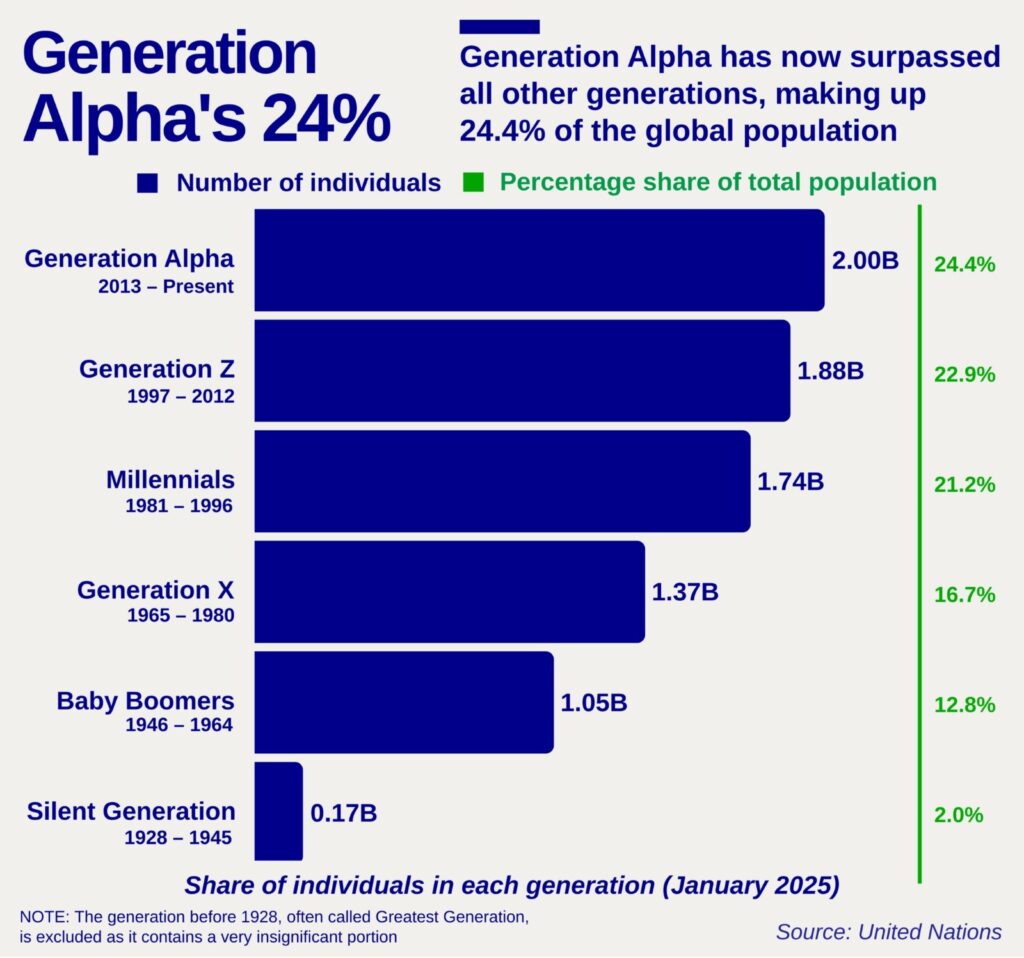
The generational shift is no longer theoretical. Generation Alpha now represents 24.4% of the global population, making it the largest generation globally. Gen Z accounts for 22.9%, and Millennials 21.2%. Together, these three groups make up nearly 70% of humanity.
This is not just a demographic transition.
It is a transformation of how work, leadership, and organizations must function.
If you are managing with a 2015 operating model, you are preparing for irrelevance.
1 – Gen Alpha: The First Fully AI-Native Generation
Generation Alpha (born 2010 onward) is the first generation that:
- Grew up with AI assistants
- Experienced algorithmic personalization as default
- Learned through YouTube, TikTok, and adaptive platforms
- Interacted with voice interfaces before keyboards
They are not “adopting” AI.
They assume intelligence is embedded in systems.
For modern business management, this means:
- Clunky legacy systems will feel unacceptable.
- Slow onboarding processes will signal incompetence.
- Static job roles will feel restrictive.
- Bureaucracy will be seen as inefficiency, not structure.
They expect:
- Seamless tech
- Automation
- Personalization
- Speed
If your enterprise software is slower than their smartphone, you lose credibility instantly.
2 – Gen Z: The Algorithm-Aware Workforce
Gen Z is already in the workforce.
They:
- Understand digital branding
- Value autonomy
- Reject traditional 9-to-5 rigidity
- Expect transparency
- Are highly aware of algorithmic influence
They do not trust institutions blindly.
They evaluate them.
AI has shaped their mindset in two ways:
- They expect tools that increase their leverage.
- They are skeptical of systems that reduce human dignity.
They want:
- Flexibility
- Impact
- Meaning
- Technology that empowers, not monitors
Modern management must recognize this shift.
Control-based management models are failing with Gen Z.
Trust-based, tech-enabled ecosystems are winning.
3 – Work Is Becoming Platform-Based, AI-Augmented
We are moving from:
Job → Role → Title → Ladder
To:
Skill → Project → Platform → Portfolio
AI is accelerating this shift by:
- Automating repetitive tasks
- Reducing administrative layers
- Enabling solopreneurs
- Lowering barriers to entry
Gen Alpha and Gen Z are growing up in a world where:
- A creator can build a global audience from a bedroom.
- A developer can launch software without a corporation.
- A freelancer can operate across borders.
They are not seeking lifetime employment.
They are seeking leverage.
Modern businesses must evolve into platforms that:
- Allow internal entrepreneurship
- Enable AI augmentation
- Reward outcomes over hours
- Provide flexible career pathways
The “career ladder” is being replaced by the “career ecosystem.”
4 – AI Is Increasing the Value of Human Judgment
Here is the paradox:
The more automation expands, the more valuable human judgment becomes.
AI can:
- Analyze
- Predict
- Optimize
- Automate
But it cannot:
- Carry ethical responsibility
- Navigate ambiguity
- Lead culture
- Inspire trust
Gen Alpha and Gen Z are entering a world where:
Routine cognitive work is commoditized.
The premium skills become:
- Ethical reasoning
- Strategic thinking
- Emotional intelligence
- Creative synthesis
- Systems thinking
Modern business management must shift training away from pure execution toward judgment development.
5 – Loyalty Is Shifting from Institution to Impact
Boomers were institution-loyal.
Gen X was career-loyal.
Millennials are value-loyal.
Gen Z and Gen Alpha will be impact-loyal.
If your organization cannot answer:
“Why does this matter?”
You will struggle to attract top young talent.
Modern management must integrate:
- Purpose into strategy
- Social impact into branding
- Sustainability into operations
- Transparency into governance
Impact is the new currency of attraction.
6 – The Leadership Shift Required
With nearly 70% of the global population being digitally native generations, leadership must evolve in three dimensions:
A- Technological Intelligence
Leaders must understand AI, automation, data ecosystems, and digital infrastructure.
B-Structural Agility
Organizations must redesign workflows around AI integration — not simply add AI tools.
C- Ethical Depth
As AI scales influence, leaders must safeguard fairness, privacy, and human dignity.
Technology without ethics destabilizes systems.
Ethics without technological literacy weakens competitiveness.
Modern business management requires both.
7 – What This Means for the Future
The rise of Generation Alpha signals:
- AI-native education models
- Hyper-personalized marketing
- Hybrid human-machine collaboration
- Distributed global talent networks
- Fluid career architectures
Gen Z is already pushing organizations to change.
Gen Alpha will accelerate that pressure.
The future of work is not the end of structure.
It is the redesign of structure around intelligence.
Final Strategic Insight
Generation Alpha and Gen Z are not just younger demographics.
They are:
- Platform thinkers
- AI-native collaborators
- Autonomy-driven contributors
- Impact-oriented decision makers
Modern business management must transition from:
- Control → Enablement
- Hierarchy → Network
- Supervision → Orchestration
- Efficiency → Intelligent Adaptability
The organizations that thrive will not be those with the longest legacy.
They will be those that integrate AI responsibly, empower human judgment, and create environments where digital-native generations can build, not just work.
The demographic shift is already here.
The management shift must follow